Late August through mid September is the best seeding window Minnesota gets all year. Soil is still warm enough for fast germination, nights have cooled off, and the weed pressure that swamps a spring seeding has mostly passed. Seed put down now has two full months to root before the ground freezes.
Which makes this the worst possible time to buy the wrong bag of seed.
Before you buy anything, it is worth deciding whether seed is the right choice at all. Our guide on choosing between seed and sod breaks down when each method makes sense for a Minnesota lawn.
The four numbers that actually matter
Every bag of grass seed sold in Minnesota carries a seed analysis label. Most people never read it. It is the only honest description of what you are buying, and four lines on it tell you almost everything.
Pure seed percentage. What share of the bag's weight is actually seed. The rest is inert matter: ground-up filler, coating, chaff. A bag that is half filler is a bag you are paying to haul home and spread on your lawn for nothing.
Perennial versus annual. Perennial grasses come back next year. Annual ryegrass germinates fast, looks great for one season, and dies. Cheap mixes lean on annual ryegrass because it makes the bag look like it worked. The following spring you are back where you started.
Germination rate. The share of that seed that will actually sprout under good conditions. Anything under 85% means you are spreading dead seed.
Weed seed and other crop. Yes, seed bags legally contain weed seed. The label tells you how much. This is how people introduce new weeds to a lawn while trying to repair it.
A real comparison
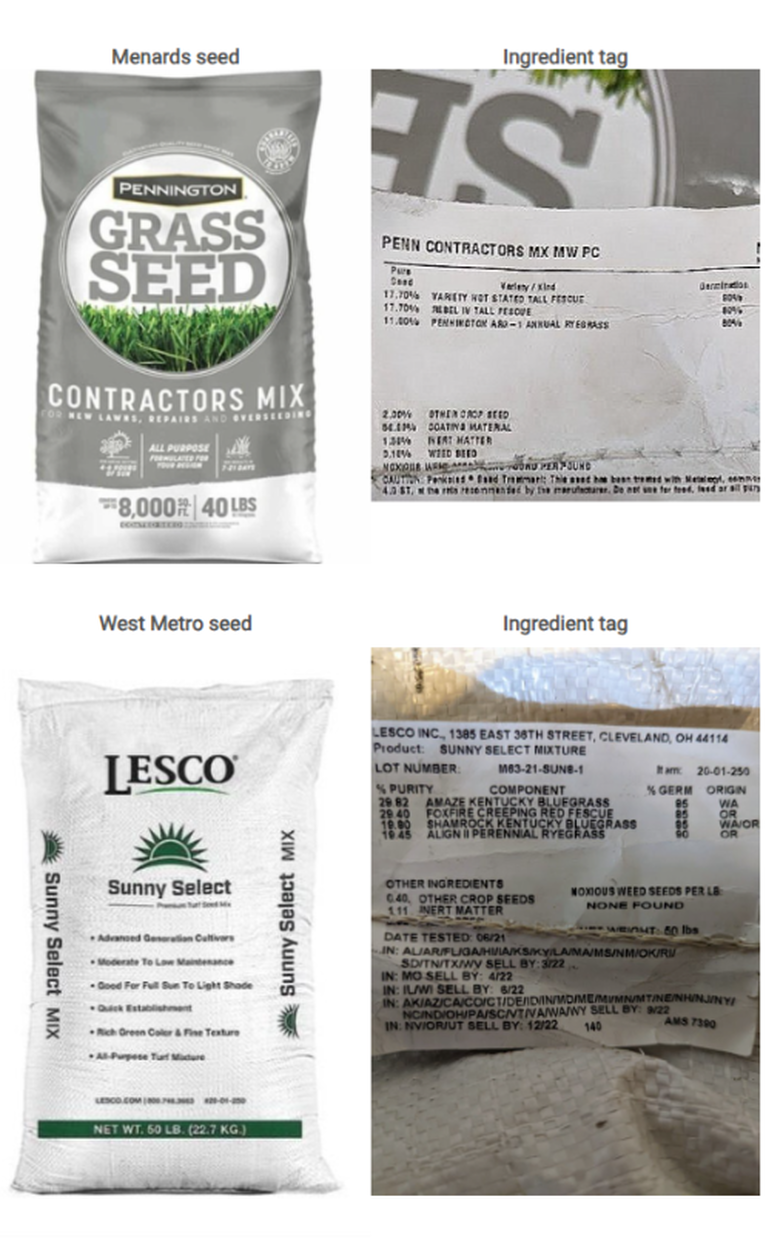
We always urge people to read the label, because not all grass seed is created equal. Here is a bag we found at the Menards checkout against what we carry.
Menards Contractors Mix
A 40-pound bag marketed at the checkout for $70.00.
- 46% of the material in the bag is seed, which is very low
- 35% is perennial seed, which is very low
- 80% germination rate, which is very low
Summary: Very bad seed. It is also the best-selling seed on the shelf.
Run the math on that bag. Of 40 pounds, roughly 18 pounds is seed. Of that, about a third is perennial. Only 80% of it germinates. You paid $70 for something like five pounds of grass that will still be there next year.
What West Metro uses
We stock three to four different types of seed and apply the appropriate seed to each individual lawn.
- 98.5% of the material in the bag is seed, which is very high
- 100% is perennial seed, which matters because perennial means it grows again next year
- 86% germination rate, which is high
Summary: Incredible seed which will yield much better results.
Nearly the entire bag is living, perennial seed. That is the difference between a repair that holds and a repair you redo every spring.
Species that belong in a Minnesota lawn
Minnesota sits firmly in the cool-season grass zone. Three species do the work here:
Kentucky bluegrass spreads by underground rhizomes, which means it fills in thin spots on its own and recovers from damage. It is the backbone of most good Minnesota lawns. It is also slow to germinate, often two to three weeks.
Perennial ryegrass germinates fast, often within a week, which makes it useful for getting cover established quickly. It does not spread, so it holds its place rather than filling in around it.
Fine fescues tolerate shade and drought far better than the other two, which makes them the answer under mature trees and on the dry edges of a property.
Good mixes blend these deliberately for the conditions on a specific lawn. That is why we carry several and match seed to property rather than spreading one bag across every job.
Seed alone is not the job
The most common way a seeding fails has nothing to do with the seed. It is seed-to-soil contact. Seed broadcast over compacted soil and existing thatch mostly sits on top, dries out, and feeds birds.
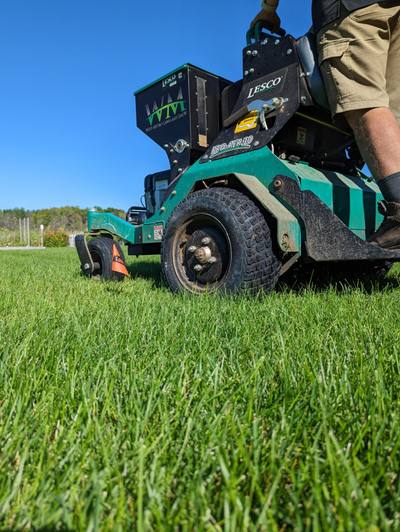
This is why seeding is paired with core aeration. Aeration pulls plugs out of the ground and opens thousands of holes for seed to fall into, where it sits against bare soil with moisture around it. Our full breakdown of the process and timing is in when to aerate and overseed your Minnesota lawn.
After seeding, keep the top inch of soil consistently damp. That usually means light watering once or twice a day for the first two to three weeks, not a single deep soak. Cutting that short is the second most common way a seeding fails.
The short version
Read the label. If pure seed is under 90%, perennial content is under 90%, or germination is under 85%, put the bag down. Good seed costs more per bag and less per square foot of lawn that is still there in two years.
Ready to overseed with quality seed? Contact us for a free estimate on aeration and overseeding.